Bankruptcy Isn't Your Only Way Out. Here Are 4 Others Most People Don't Know About
By Your Debt Advocate · Updated 2026
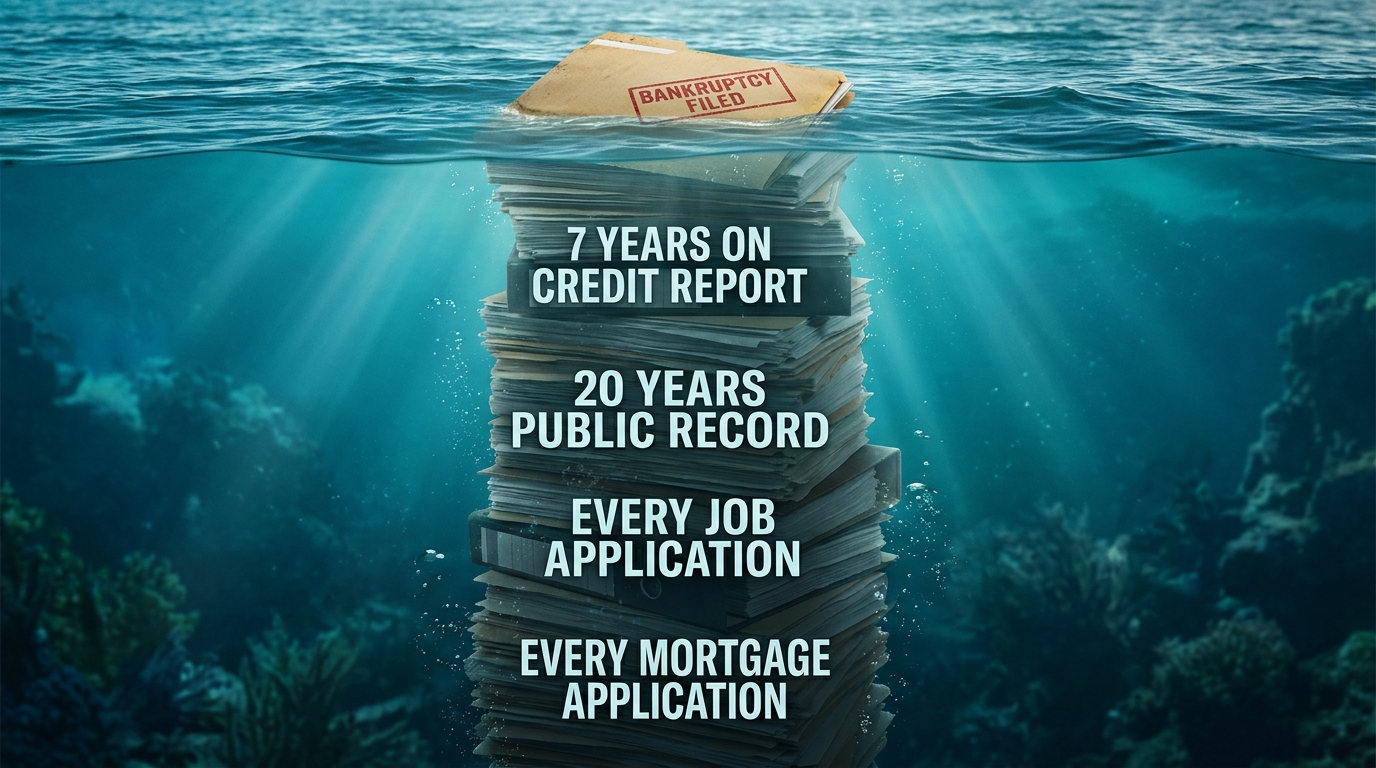
Most families who file bankruptcy didn't actually need to.
That isn't a judgment of anyone who has filed. It's the honest math. Bankruptcy is one of five ways out of consumer debt. For some families, it really is the right tool. For most families who end up filing, one of four other paths would have worked — they just didn't know those four paths existed before the situation got desperate.
This page lays out what bankruptcy actually does, who it really fits, and the four alternatives most people only hear about after they've already filed.
The Four Alternatives, Up Front
Before we get into bankruptcy itself, here are the four other paths. Each one fits a specific kind of situation. None of them have the public record consequence bankruptcy carries.
Alternative 1: Debt Forgiveness
A structured negotiation that resolves your unsecured debts for less than face value. Typically settles accounts at 40-60% of original balance over 24-48 months. Best for: Families with $10,000+ in unsecured debt who can't realistically pay every dollar back, but DO have some monthly capacity to build settlement savings.
Alternative 2: Credit Counseling (Debt Management Plan)
A nonprofit agency negotiates lower interest rates with your creditors and puts you on a 3-5 year payment plan. Best for: Families with under $10,000 in card debt, stable income, and the discipline to stay off cards for 3-5 years.
Alternative 3: Direct Hardship Programs
Most card companies have internal hardship programs that drop interest rates to 0-9% for 12 months and waive fees if you call and ask. Most people never call. Best for: Families with under $15,000 in card debt who have stable income but got hit by a temporary shock — medical event, layoff, divorce.
Alternative 4: Statute-of-Limitations Wait
Each state has a statute of limitations on consumer debt — typically 3-6 years depending on the state and debt type. Once it expires, the debt cannot be sued on. The debt does not go away from your credit, but it loses its legal teeth. Best for: Older debts that have already aged most of the way through the limitations period AND are no longer actively reported. This path requires careful timing and an understanding of what restarts the clock.
Most families never see any of these four paths laid out side by side. They walk into a bankruptcy attorney's office because they didn't know they had options. The bankruptcy attorney files what bankruptcy attorneys file.
What Bankruptcy Actually Is
Bankruptcy is a federal court process. It is governed by Title 11 of the U.S. Code. There are several types, but for consumer debt only two matter:
Chapter 7 (Liquidation)
The court discharges most unsecured debts in 3-6 months. Some assets may be liquidated to pay creditors. Most household goods, retirement accounts, and a portion of home equity are protected by federal and state exemptions. To qualify, you have to pass a "means test" that limits Chapter 7 to families below the median income for their state and household size.
Chapter 13 (Reorganization)
The court puts you on a 3-5 year repayment plan. Some debts get paid in full, some get reduced, some get fully discharged. You keep your house and car as long as you stay on the plan. Chapter 13 is used when a family has too much income to qualify for Chapter 7 OR has secured debts (mortgage, car) they want to catch up on while protecting assets from foreclosure or repossession.
Both types involve filing fees, attorney fees, mandatory credit counseling courses, court appearances, and disclosure of all your finances. A bankruptcy attorney handles the filing and the proceedings. Current filing fees: $338 for Chapter 7 and $313 for Chapter 13 (US Bankruptcy Court fee schedule, unchanged since December 2023).
Who Bankruptcy Actually Fits
Bankruptcy is the right tool for families who:
- Have genuinely no realistic path to ever pay these debts back, even at reduced amounts
- Were hit by something catastrophic — long-term illness, multi-year unemployment, divorce that destroyed both households, business failure with personal guarantees
- Are facing imminent foreclosure or wage garnishment that needs to be stopped immediately (the automatic stay that comes with a bankruptcy filing halts most collection activity overnight)
- Owe types of debt that the four alternatives above cannot resolve — large IRS tax debt over 3 years old, certain student loan situations under specific conditions, court judgments
- Need a clean legal slate to rebuild from zero, not a partial resolution
For these families, bankruptcy is a real legal protection that exists exactly for situations like theirs. Pretending otherwise is dishonest.
The Real Cost Most People Don't Find Out About Until It's Too Late
Bankruptcy works. It also costs more than the filing fees and the lawyer's bill. The actual cost includes a tail of consequences that doesn't show up in the pitch.
Cost #1: Credit Report (7-10 Years)
Chapter 7 stays on your credit report for 10 years from the filing date. Chapter 13 stays for 7 years. During that window, your access to credit gets significantly more expensive. Higher mortgage rates if you can get a mortgage at all. Higher car loan rates. Higher insurance premiums in some states. Refused for many credit cards entirely.
The credit damage is real. It also recovers — most filers see meaningful score recovery within 2-3 years if they handle credit responsibly post-filing. The 10-year mark is when the bankruptcy notation falls off, not when the score finally recovers.
Cost #2: Public Court Record (Roughly 20 Years)
This is the one that surprises most people. Bankruptcy filings are public court records. They go into PACER (the federal court records system) and stay searchable for roughly 20 years.
What that means in practice: anyone with $50 and your name can search and see that you filed bankruptcy. Anyone running a background check on you for any reason can see it. The public record stays online long after the credit report scrub.
Cost #3: Application Disclosure (For Life)
This is the cost most filers don't realize until years later. Many forms ask "have you ever filed for bankruptcy?" That question doesn't say "in the last 7 years." It says "ever."
The honest answer is "yes" for the rest of your working life. That answer shows up on:
- Some job applications (especially in finance, government, security clearance roles)
- Most mortgage applications, even decades after filing
- Some apartment rental applications
- Some business loan applications
- Many professional license renewals (varies by profession)
- Some insurance applications
Lying on these forms is fraud. Telling the truth means the bankruptcy keeps appearing in your life long after the credit notation has faded.
Cost #4: Some Debts Survive Anyway
Bankruptcy does not discharge everything. The following types of debt usually survive bankruptcy:
- Most federal and private student loans (with rare exceptions for "undue hardship")
- Most recent IRS tax debt (taxes less than 3 years old, or fraud-tagged)
- Court-ordered child support and alimony
- Court fines, criminal restitution, certain government penalties
- Debts incurred by fraud (cards run up right before filing, for example)
If a significant portion of your debt is in one of these protected categories, bankruptcy may not solve your problem.

If you're considering bankruptcy, get the answer to two questions before signing anything. First — what does the bankruptcy attorney charge? Second — how much would debt forgiveness cost on the same debt amount? Get both numbers in writing. Compare on paper. Then pick.
The Honest Comparison: Bankruptcy vs. Debt Forgiveness
For most families considering bankruptcy for unsecured debt — credit cards, personal loans, medical bills, store cards — the closest peer path is debt forgiveness. Here's how they actually compare.
| Chapter 7 Bankruptcy | Debt Forgiveness | |
|---|---|---|
| Time to debt-free | 3-6 months | 24-48 months |
| Total out of pocket | $1,500-$3,000 (filing fees + attorney) | 40-60% of debt face value over 24-48 months + specialist fee (~15-25%) |
| Credit impact (during) | Hard hit immediately upon filing | Hard dip during settlement phase |
| Credit recovery starts | Slow — 2-3 years after discharge before meaningful improvement | As accounts settle and close as "settled" |
| Public record | Yes — searchable for ~20 years | None |
| "Have you ever?" disclosure | Yes — for life on many forms | None |
| What gets discharged | Most unsecured debt; some types survive | Each enrolled account, settled one at a time |
| Tax implications | Discharged debt is generally NOT taxable | Forgiven amounts may be reported on 1099-C; insolvency exclusion often applies |
| Stops collection calls / lawsuits | Yes — automatic stay upon filing | Most settle before lawsuit; specialist coordinates if filed |
The bankruptcy timeline is faster. The total out of pocket is lower in raw dollars. The credit damage is harder up front and the public record lasts longer.
For a family with stable monthly income and $10,000-50,000 in unsecured debt that they can't realistically pay full, debt forgiveness is usually the better tool. They keep the public record clean. They take the credit hit only on the credit report side, not the public-court-record side. They typically recover credit faster.
For a family with no realistic monthly income to even build settlement savings, or with tax debt and judgments that bankruptcy can clear, bankruptcy is the better tool.
The honest answer depends on your specific situation. The honest mistake is filing bankruptcy without ever finding out what the alternatives would have looked like for your numbers.
How to Tell Which Path Fits You
Run your situation against these honest questions.
Do you have any monthly income above your basic survival expenses?
If yes — even $200/month — debt forgiveness can build settlement savings. If genuinely no, bankruptcy may be the right tool.
Are you facing imminent foreclosure or wage garnishment that has to be stopped this month?
If yes, bankruptcy's automatic stay is one of the few tools that stops most collection activity overnight. Other paths take longer to get a creditor to stand down.
Is most of your debt in categories that bankruptcy doesn't discharge?
If most of your debt is student loans, recent IRS tax debt, child support, or court judgments, bankruptcy may not solve your problem. Other paths may not either, but you need an honest review of what bankruptcy would actually clear before assuming it's the answer.
How important is keeping bankruptcy off your record for the next 20 years?
For some families — those in finance, government, professional licensing, real estate — the public record is a real career and life issue. For others, it doesn't matter much. Be honest about which side of that line your family falls on.
What is the actual all-in cost on each path?
Bankruptcy attorney fees plus filing fees vs. debt forgiveness specialist fees plus settlement savings. The numbers can be closer than people assume — and the all-in cost is what matters, not the headline timeline.
What To Do Next
- Don't file yet. Bankruptcy is permanent in important ways. The 30 minutes it takes to look at the alternatives is worth taking before signing.
- If you've been served with a lawsuit or are facing imminent foreclosure, time matters. Get a senior specialist or bankruptcy attorney to look at your situation immediately. Don't drag it out.
- If you're early in the process, look at the alternatives. Use the hub article to compare. Run your numbers against debt forgiveness, credit counseling, hardship programs, and bankruptcy side by side.
- Take the Free Debt Relief Assessment. A senior specialist will run your numbers and compare paths honestly. If bankruptcy turns out to be the right fit, they'll say so and refer you to a qualified bankruptcy attorney.
Common Questions About Bankruptcy
Will I lose my house if I file Chapter 7?
Most families don't, but it depends on your state's homestead exemption and how much equity you have. Federal exemptions protect roughly $31,575 of home equity for individual filers (about $63,150 for joint filers) — figures effective April 1, 2025 and adjusted every three years. State exemptions vary widely. Florida and Texas have unlimited homestead exemptions for primary residences. New Jersey and Pennsylvania have very small ones. A bankruptcy attorney runs the math for your specific state.
Will I lose my car?
Most families keep their car if they're current on the payments AND the equity falls within the state's vehicle exemption. Federal exemption protects about $5,025 of car equity (effective April 1, 2025). If the car is upside down on the loan, there's no equity to lose anyway.
Can I file bankruptcy on just credit card debt?
Bankruptcy is all-or-nothing — you can't choose which debts to include. You list everything. The court treats different debt types differently, but you can't selectively file on cards while keeping medical bills out.
How long after bankruptcy until I can get a mortgage?
FHA loans can be available 2 years after Chapter 7 discharge with re-established credit. Conventional loans typically require 4 years. Chapter 13 requires 1-2 years of on-plan payments before some loans, 4 years after discharge for conventional. Rates are usually higher than for borrowers without bankruptcy history.
Does bankruptcy affect my spouse if we file separately?
Generally no — your spouse's separate credit is unaffected. Joint debts are different. If a debt has both your names on it, the spouse who didn't file may still be liable for the full balance even after the filer's discharge. State community property rules can change this in CA, TX, AZ, NM, NV, ID, LA, WI.
Can I keep credit cards through bankruptcy?
Most card companies will close any account in your name when bankruptcy is filed, regardless of whether you listed that card. You'll generally need to rebuild card access from zero post-discharge.
What's the difference between bankruptcy and debt forgiveness for the IRS?
Discharged debt in bankruptcy is generally NOT considered taxable income. Forgiven debt outside bankruptcy may trigger a 1099-C from the creditor, but the "insolvency exclusion" under IRC Section 108 protects most families if total debts exceeded total assets at the time of forgiveness. A tax preparer files the right form. The exclusion applies to most forgiveness situations because the families involved are by definition financially stressed.
Sources & References
U.S. Bankruptcy Code, Title 11. U.S. Bankruptcy Court schedule of fees ($338 Chapter 7, $313 Chapter 13, per current schedule). Fair Credit Reporting Act, 15 U.S.C. Section 1681c, credit reporting time limits (10 years for Chapter 7). PACER federal court records. Internal Revenue Code Section 108, insolvency exclusion. Federal exemptions per 11 U.S.C. Section 522 (homestead $31,575 individual / $63,150 joint, vehicle $5,025, effective April 1, 2025 through March 31, 2028). Means test per the Bankruptcy Abuse Prevention and Consumer Protection Act of 2005.
This article is for consumer education only. It is not legal advice. Your Debt Advocate is not a law firm. Bankruptcy involves federal court procedures and should be handled with a qualified bankruptcy attorney for any specific filing decisions. A senior debt specialist can compare bankruptcy against the four alternatives through the Free Debt Relief Assessment and refer you to qualified counsel where appropriate.
Compare Bankruptcy Against the Alternatives
Bankruptcy is one common path. For some families it's the right one. For most who file, one of the alternatives would have worked — they just didn't see them in time. Get a comparison before signing.
Free Assessment
Compare bankruptcy against the four alternatives for your specific situation. Get the numbers side by side.
"Have you ever filed for bankruptcy?" doesn't say "recently." It says "ever." That answer follows you for life. Make sure it's the right answer to be carrying.